Tuesday, November 17, 2009

-2o1o- DotA Assistant

Introduction
DotA Assistant is a program fully built in Java, with pixel scanning merchanism as the core. It's meant to work alongside with Warcraft III : DotA, with the features listed as follows:

Main features :
  • Detecting opponent heroes and notifying the user when the program loses vision of the heroes in the minimap
  • Assessing the battling ability of heroes and displaying the probability of one hero winning another to the user

Note : Bear in mind that this program is still heavily being tested and the information produced are therefore susceptible to inaccuracy.


The Hero Detection System

At the beginning of the game the program will scan the minimap and register the hero when its found by the scanner.


When any of the registered heroes appear to be missing, the user will be notified by the program about the absence of the hero.


The hero will also be notified when the hero is no longer absent.


The Hero Assessment System
The hero assessment system basically retrieves the attribute information of the hero(es) and produces useful information such as the effective hitpoints, attack cooldown, amount of time needed for a hero to kill another hero, and the probability of a hero winning another hero.
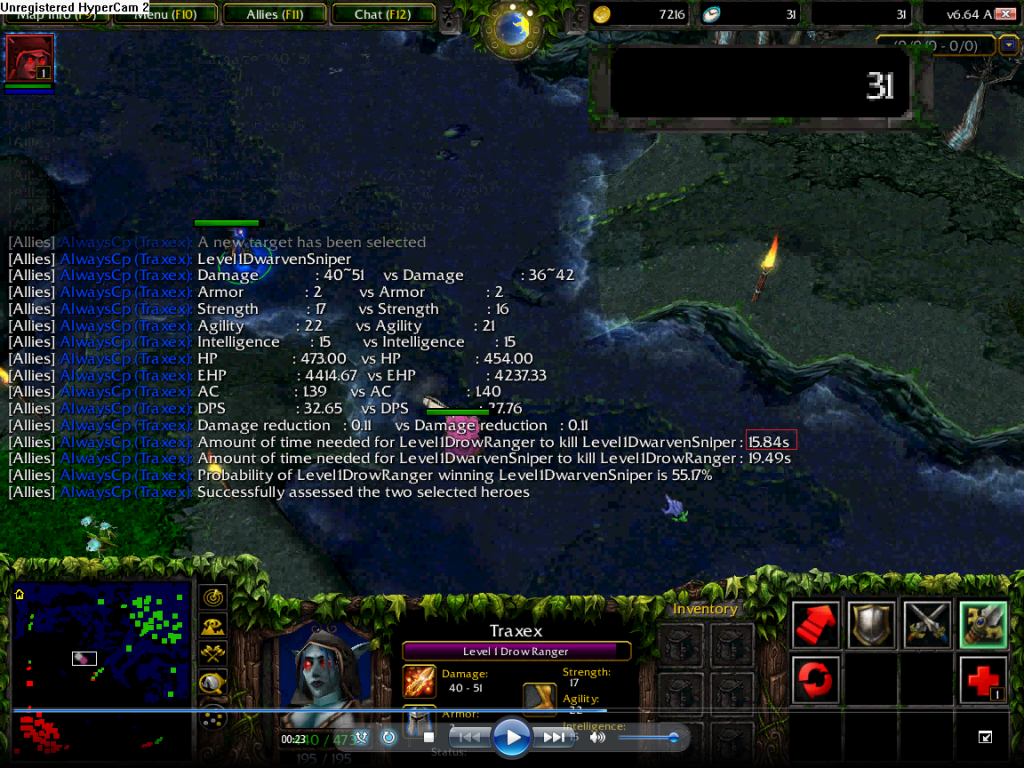
(The timer starts at the moment the projectile of my hero's shot reaches my opponent)

The screenshot above demonstrates the output produced by the hero assessment system. Pay more attention to the fourth line counting from the bottom, Amount of time needed for Drow Ranger to kill Dwarven Sniper and the magnified timer on top(click on the ss if you're unable to view it in full).
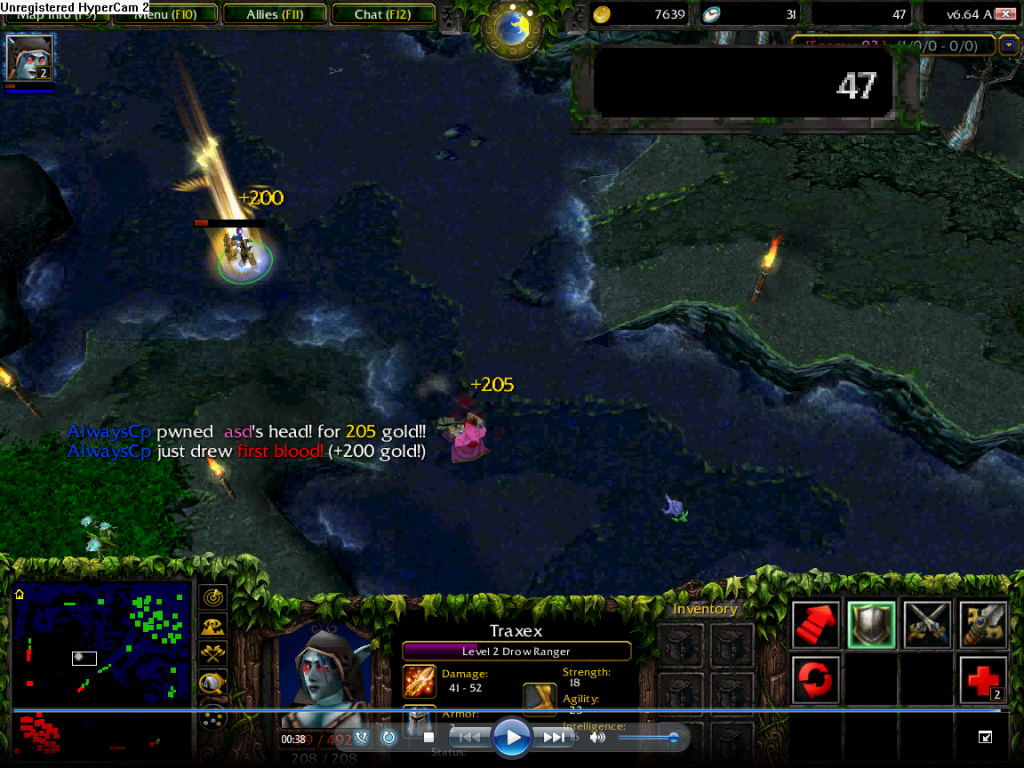


The magic of mathematics,
31 + 15.84 = 46.84s = 47s(as shown in the screenshot)


Note : The information produced only serve as a benchmark for the user to gauge the battling ability of the selected hero. By the program telling me that my hero needs 15.84s to kill my opponent DOES NOT mean that my hero would take that amount of time to kill the hero when it comes to real-play situation.


Nature of the program
It's always more interesting when it comes to the conceptual explanation of any of the -2o1o- grand releases because their true beauty and elegance do not come from the output it produces to the user, which I've briefly covered some of them above; it conversely comes from the inner design of the program: the robustness of algorithm, the style of programming logic, the control flags, the playaround of APIs. These are the few elements, which forms the core, the foundation of the program.

Please do not feel perplexed as you scroll down and read the walls of technical terms/graphical illustration. Trust me, its not as hard as it seems if you have the foundation in programming; you just have to be ready work with pixels and myriads of RGB codes

This program technically encompasses of three main modules:
  • The Minimap Scanner
  • The Name Scanner
  • The Attribute Scanner


The Minimap Scanner

The program uses Robot API to create an image capture at the minimap region of the screen(captured image as shown in the picture above). Initially the program was set to scan at an incremental value of 3 for both the x and y value each time it moves, it was however being found out that the algorithm could not achieve the intended accuracy after performing several stages of testing.

For the sake of producing promising information to the user(I would not say its 100% accurate but at least the inaccuracy is pardonable), I've decided to use the performance-accuracy tradeoff approach. The accuracy of the scanner was increased at the expense of the CPU performance by decreasing the incremental value for both x and y from 3 to 1, thus proportionally increasing the number of pixel scans from 4333 1/3(195 x 200 / (3x3)) to 39000(195 x 200 / (1x1)) scans for each cycle(195 x 200 is the size of the minimap).

Note : For users with low computer performance, the minimap scanner will hog a considerable amount of CPU usage whenever its scanning takes place. I'll revise the algorithm so that it overcomes such deficiency if there's a high demand from the users.

Once the program found a pixel containing the RGB value listed in the predefined sets of RGB range, it will register the found pixel as an identifier of a player, in accordance with the player number set for the predefined range of RGB codes

If any of the opponent heroes happens to be missing from the sight of the user or his/her allied units, the mini dot corresponding to the missing hero would likewise be missing from the minimap. This event would render the minimap scanner unable to scan for the missing hero range of RGB codes, thus making it consider the hero missing from the map. When this happens, the Robot API typeMessage() method would explicitly be invoked by the program to send a message notifying the user regarding the absence of the hero.


The Name Scanner
Its the human's nature for being able to recognize the letters at a glance, irregardless of how badly written the letter is or how much the letter deviates from its actual style. This is also the main reason why image verification mechanism become one of the most powerful and prominent security measure in the world.

But let's face it, computer processes at a speed where not even millions of our human brain could beat it. When it comes to character recognition, I certainly do not deny the fact that the computer may not be able to recognize letter as good as the human at first; but when its crafted with a well structured algorithm defining the technical way of recognizing the letters in procedural manner, it's not a total impossibility for a computer attain the same level of character recognition as the human. When this stage is achieved, the level and amount information a computer produces over time could far surpass the human.

I crave your pardon for being slightly out of topic, but this is exactly what's on my mind before it comes to the development of the scanners, especially the name and attribute scanners. You see, being able to analyse up to 10k characters and generating up to thousands lines of information per sec to the user, I believe that it's not beyond the bounds of possibility for a player to play DotA in a complete flawless style. Let's get back on topic, introducing you the second core module of the program - the name scanner.


Similar to the aforementioned minimap scanner, the name scanner uses Robot API to capture an image of the region which contains the level and the name of hero.


The only difference is that the y value works as a baseline and remains as a constant whenever the name scanner does its scanning, whereas the value of x changes as the scanner pointer moves. The scanner travels on x axis, on the basis of pixel by pixel, ignores every black pixels it come across and stops at the point where a white pixel is detected.

Take the picture above as an example, the first point, with the coordinate being (538,733), is the point where the scanner stops(we call it the point of origin) to scan for the pattern of the character it stops at(in this case its the letter L), and compares with the predefined pattern points to determine what letter it is.


The letter which resides on the point of origin has to match all the predefined pattern points before it's being recognized as the corresponding letter. For simplicity's sake, I'll omit 8 out of 12 of the pattern points for the letter L, leaving only 4 pattern points to be discussed.

Note : the combination of both integer value x and y form a pattern point which denotes the distance of the pattern point from the point of origin.

Since 8 of the pattern points for the letter 'L' have been omitted, lets just deny their existence. Don't look at them, don't even think of the purpose of them being there; just focus on the four points circled in red.

Note : The coordinate system in computer does not work the same as the Cartesian coordinate system, the decrement of value y in the computer system indicates that the point is moving upwards instead of downwards. In another word, the smaller the value y of a point, the higher the position of the point in the computer coordinate system.


The scanner begins by checking the first pattern point for the letter 'L', (0,-4). If the pixel 0 x and -4 y distance away from the origin is a white pixel the scanner will proceed to the second pattern point; if its a black pixel, the scanner directly negate the possibility of the letter being 'L'. In this case the origin is (538,733) and the pixel at the position 0 x and -4 y distance away from the origin is not a black pixel.

Next, the scanner will check the second pattern point for the letter 'L' (1,-4).
Similar to the concept above, if the pixel at the position 1 x and -4 y distance away from the origin is not a black pixel, the program will preserve the possibility of the letter being 'L' and continue to check for the next pattern point.

The process repeats until the scanner reaches the last pattern point.
If every of the pixels scanned does not appear to be a black pixel to the program, the program will recognize the letter as the corresponding letter(in this case the program will recognize the letter above as a 'L').


The character precedence
Now we've finished about the character recognition part; the program could now recognize the letters individually if we supply the pattern points as a guideline for the program, but what happens if the program tries to recognize letters bearing a resemblance to another letter?

For instance, the letter c could be recognized by the program as an 'e' and the letter l could be recognized by the program as a 'L', owing to the fact that the letter e and l have all the pattern points for the letter c and L respectively. When the scanner scans the line of text 'Level 1 Bone Fletcher' it will produce the output Llecvecl 1l Bocnec Fllectlchlecr.


A simple workaround for this is to specify a set of precedence for every of the letters bearing a resemblance to another letter. Taking the first part as an example, if the scanner scans and recognizes a letter being both letter a and i, it will negate the possibility of the letter being 'i' because logically the letter a has more pattern points(more pixels) compared to the letter 'i'.


The Attribute Scanner

The attribute scanner does not differ much from the name scanner except that instead of having only one baseline, the attribute scanner scans on 5 different elevation of y axis. After the translation of pixels to numbers, the translated numbers will be passed to the DotALogic class to process other information which the users may deem useful, such as the EHP, DPS, AC, damage reduction, hp regen, mp regen. The formulas to perform calculation as such are listed as follows:

Assume that
Average Damage = avgDmg
Minimum Damage = minDmg
Maximum Damage = maxDmg
Additional Dmg = addDmg
Total Dmg = totalDmg
Attack Cooldown = AC
Damage per second = DPS
Effective HP = EHP
Hit point = HP
Time needed to kill = TNTK
Probability of winning = PoW
Additional Agility = addAgi
Damage Reduction = dmgReduction
Additional Armor = addArmor;
Hero1 = First hero to be compared
Hero2 = Second hero to be compared


avgDmg = (minDmg + maxDmg) * 0.5


totalDmg = avgDmg + additionalDmg


AC = baseAC / (1 + ((agi + addAgi) * 0.01))


DPS = (addDmg + avgDmg) /AC

DPS = (addDmg + avgDmg) / ( baseAC / (1 + ((agi + addAgi) * 0.01)))
dmgReduction = 1 - (1 / (1 + ((armor + addArmor) * 0.06)))


EHP = HP/damageReduction

EHP = HP / 1 - (1 / (1 + ((armor + addArmor) * 0.06)))


Hero1.TNTK = Hero2.HP / ((Hero1.totalDmg * (1-Hero2.dmgReduction / Hero1.AC) )-Hero2.HPRegen)

Hero1.TNTK = Hero2.HP / (((((Hero1.minDmg + Hero1.maxDmg) * 0.5) + Hero1.additionalDmg) * (1-(1 - (1 / (1 + ((Hero2.armor + Hero2.addArmor) * 0.06)))) / (Hero1.baseAC / (1 + ((Hero1.agi + Hero1.addAgi) * 0.01)))) )-Hero2.HPRegen)


Hero2.TNTK = Hero2.HP / ((Hero2.totalDmg * (1-Hero1.dmgReduction / Hero2.AC) )-Hero1.HPRegen)

Hero2.TNTK = Hero1.HP / (((((Hero2.minDmg + Hero2.maxDmg) * 0.5) + Hero2.additionalDmg) * (1-(1 - (1 / (1 + ((Hero1.armor + Hero1.addArmor) * 0.06)))) / (Hero2.baseAC / (1 + ((Hero2.agi + Hero2.addAgi) * 0.01)))) )-Hero1.HPRegen)


Hero1.PoW = 1 - Hero1.TNTK / Hero1.TNTK + Hero2.TNTK

Hero1.PoW = 1 - (Hero2.HP / (((((Hero1.minDmg + Hero1.maxDmg) * 0.5) + Hero1.additionalDmg) * (1-(1 - (1 / (1 + ((Hero2.armor + Hero2.addArmor) * 0.06)))) / (Hero1.baseAC / (1 + ((Hero1.agi + Hero1.addAgi) * 0.01)))) )-Hero2.HPRegen)) / ((Hero2.HP / (((((Hero1.minDmg + Hero1.maxDmg) * 0.5) + Hero1.additionalDmg) * (1-(1 - (1 / (1 + ((Hero2.armor + Hero2.addArmor) * 0.06)))) / (Hero1.baseAC / (1 + ((Hero1.agi + Hero1.addAgi) * 0.01)))) )-Hero2.HPRegen))+(Hero1.HP / (((((Hero2.minDmg + Hero2.maxDmg) * 0.5) + Hero2.additionalDmg) * (1-(1 - (1 / (1 + ((Hero1.armor + Hero1.addArmor) * 0.06)))) / (Hero2.baseAC / (1 + ((Hero2.agi + Hero2.addAgi) * 0.01)))) )-Hero1.HPRegen)))


Future enhancement

  • Item recognition
    I've already completed coding the algorithm its just that the process of extracting up to 3k sets of item RGB codes is a big hurdle for me, even with the assistance of an API written intentionally for this purpose.
  • Skill prediction
    To calculate the damage and predict the sequence of skill the opponent will use on the user's hero
  • Enhanced version of hero assessment system
    Enhanced version of hero assessment version will take orb effects such as critical strike, life steal and bashing into account.
  • Performance
    The current algorithm scans up to 500k or even 1 million pixels per second would gradually lead to CPU exhaustion, it needs to be revised and rewritten.


(a screenshot of the database for item recognition module in 0th Normalization Form 0NF)

I won't release the executables or the source code anytime soon because currently the codes are still at the level of content coupling and commucational cohesion and furthermore there are still lots of architectural revision to be made.

Tuesday, November 18, 2008

-2o1o- Cracking SHA1/SHA512/MSSQL hashes

--

-2o1o- Challenge spoofing/NTLM downgrading

--

-2o1o- An example of ARP poisoning(HTML form password stealing)

--

-2o1o- Birthday Attack!

The Birthday Paradox

In probability theory, the birthday problem, or birthday paradox[1]
pertains to the probability that in a set of randomly chosen people some pair of
them will have the same birthday. In a group of 23 (or more) randomly chosen
people, there is more than 50% probability that some pair of them will both have
been born on the same day. For 57 or more people, the probability is more than
99%, reaching 100% as the number of people reaches 366.[2] The mathematics
behind this problem leads to a well-known cryptographic attack called the
birthday attack. [Wikipedia.org]


“How many birthdays does a person have in a year?”
“One”
“Then assume in a group of 23, how do we calculate the probability of a person having the same birth date as another?”
“Since the probability of one person’s birthday falls on a day is 1/365, so in a group of 23 it would be 23/365 = 6.3%”
(not taking the presence of leap years into account)

WRONG


So what’s the right way of answering this?
The simpler version of formula is
(number of people * (number of people – 1) ) / 2
(23 * 22) / 2 = 253 pairs

If you’re so inclined to find out the proper way of solving the case above, you can search for permutations and combinations on the web. Yea, and be prepared to work with big numbers.

Next, we calculate the probability of one person’s birthday DOESN’T fall on a day, and that would be
364/365 = 0.99726 (99.72%) it seems really big now but trust me, after a number of self multiplication, it shrinks really fast

we then apply the 253 as the exponent since now we are trying to get the probability of 253 pairs(group of 23).

and it would be

0.99726^253 = 0.4995 (49.95%) get what i was trying to say?

Now we’ve gotten the probability, but we are not done yet. Note that we were only focusing on the problem scenario (with the keyword DOESN’T), so in order to get the probability of a group of 23 sharing the same birth date we would do

1 – 0.4995 = 0.5005 (50.05%)


A graph showing the approximate probability of at least two people sharing a birthday amongst a certain number of people.


Now that we’ve calculated the number of pairs, the problem scenario’s probability and the actual probability. So what does it got to do with cryptography?

The Digital Signature
We are proceeding to the interesting part; let’s take the common archetypes in cryptography as an example: Alice, Bob, Mallory, Carol and Bob. Suppose that Alice wants to send an encrypted letter to Carol, and with the content that she wants to recommend Dave as the IT manager in the company, her letter would look something like

Dear Carol,
I would like to recommend Dave as the IT manager of our company because from my observation he has the potential to handle the role as an IT manager. Furthermore he is hardworking and does not late..

Then the Alice would digitally sign the letter using PGP(Pretty Good Privacy) and hand it to her secretary Mallory. However due to some personal disputes Mallory had with Dave, Mallory does not want Dave to hold the position. Hence, she would write another letter to stop Dave from getting the job and the letter would look like

Dear Carol,
I feel that Dave is not a perfect candidate for the role as the IT manager because he is often late and does not show any commitment in his work. Furthermore he does not know how to cooperate with his colleagues..

Indeed this letter would be perfect for Mallory to achieve her goal, but obviously Carol would not sign this letter and it is computationally infeasible for Mallory to obtain the private key from the digital signature. To further enhance your understanding on how the Birthday Attack takes place in this scenario, I will break down the following explanation into steps.

1. Alice is given two keys. One is called the public key and another one is called the private key.
2. The public key is given to anyone who needs it, but the private key is kept to her only.
3. Both one of the key can encrypt the data and the other key can be used to decrypt the data
4. Alice can encrypt the letter using her private key and Carol can decrypt the letter thereafter using her public key and vice versa. Mallory has the access of the encrypted letter but without the Alice's private key she can do nothing with it.
5. In order to sign a document, Alice will convert the letter into just a few lines by a process called “hashing” (ie: MD5, SHA). These few lines are called the message digest, and since it was created using one-way-hash function, it cannot be reverted back to its initial plaintext form.
6. Alice then encrypts the message digest using her private key and that would produce the digital signature.
7. Alice attaches the digital signature to the letter and passes it to her secretary Mallory, asking her to pass the encrypted letter to Carol.
8. Mallory decrypts the digital signature back to the message digest form.

A diagram showing how a RSA digital signature is applied and then verified. (DSA and NR differ slightly.) [Wikipedia.org]

We assume that the letter
Dear Carol,
I would like to recommend Dave as the IT manager of our company because from my observation he has the potential to handle the role as an IT manager. Furthermore he is hardworking and does not late..

produces the message digest
iOJfioJcioSJSfioJSVkSMflsdfkLNSgWIjfLImnvcLKFnLhfIOShfIEGNLSnbZLSHgfIHFLHGliHklvNSlgfNSLHISLIhfLnfLIjhgPQOgpGiqojOGVIAOJBKdmaKLdnVJW

and the letter
Dear Carol,
I feel that Dave is not a perfect candidate for the role as the IT manager because he is often late and does not show any commitment in his work. Furthermore he does not know how to cooperate with his colleagues..

produces the message digest
SGIOPDOPvmKFmvklNLSDKFLWGOPvjWIPGKBVmWKLVnLKTJWPFjIPtfwnMCnMFWPGUWJbpJKVCM:LKCMQJFaOIBPOKjfSFjKSfjKSLvjKLvKSjvSjdfjsf

If Mallory were to substitute the second letter with the original one and pass it to Carol, she would be able to tell that the letter has been substituted since the message digest produced by the hashing function of the second letter does not match the message digest produced by the decryption of the digital signature.


The Birthday Attack takes place
Mallory writes the letter again
Dear Carol,
I (feel think) that Dave (is not isn’t) a perfect candidate for the role as the IT manager because (he is he’s) (often always) late and (does not doesn’t) show any (commitment responsibility) in his work. (Furthermore Moreover) he (does not doesn’t) know how to (cooperate work) with his colleagues..

The ( aa bb ) denotes the alternative usage of word, which means either aa or bb can be used to produce different variation of letters while keeping the message conveyance of the letter intact. Since there are 9 combinations of alternative words, Mallory is able to generate up to 2^9 amount of similar letters using all the possible alternative pairs. Mallory would then hash all of the generated letters and given enough of combinations she would eventually be able to come up with a letter with exactly the same message digest as the original one.

For example,
Letter (257/512)
Dear Carol,
I think that Dave is not a perfect candidate for the role as the IT manager because he is always late and doesn’t show any responsibility in his work. Moreover he does not know how to work with his colleagues

Message Digest :
SfiPSJifoSJidfOSJDIONGWIOSNVISjfWPJDiMvNWkjdHSDjASHfuSHfoSHfoWSHfjSHDjhfushfOUShfJShfOSdhAODHOAhfOWSFhSJfhSdjHJSdhUShJfhSJfhJSHFj
(does not match with the original one)

Letter (412/512)
Dear Carol,
I feel that Dave isn’t a perfect candidate for the role as the IT manager because he’s often late and doesn’t show any commitment in his work. Moreover he does not know how to work with his colleagues

Message Digest :
iOJfioJcioSJSfioJSVkSMflsdfkLNSgWIjfLImnvcLKFnLhfIOShfIEGNLSnbZLSHgfIHFLHGliHklvNSlgfNSLHISLIhfLnfLIjhgPQOgpGiqojOGVIAOJBKdmaKLdnVJW
(matches the original one)

Consequently, Carol would not be able to notice that the letter has been altered since the letter generates the same message digest as the digital signature.


The Birthday Attack program

I've written a program to prove the mathematics behind the probability theory. In the program there's only one constructor, accepting two parameters.

public BirthdayAttack(int itemRange,int amount) {

I shall stick to the example given above, using the same itemRange(the days) and the amount(the number of people in a group)

public static void main(String[] args) { BirthdayAttack ba = new BirthdayAttack(365,23); ba.generate(); ba.compare(); ba.calculate(); }

The Output

Generated numbers
-----------------
39
155
191
327
352
163
121
282
8
166
210
182
331
310
29
358
352
285
71
92
66
353
28
--End of number generation--

2 352 spotted

The probability :
50.048%

Download Link(Megaupload)

JAVA : Client-Server based ATM Simulation with SSL Encryption

Screenshots

ATMClient

Bank Server


Packets before SSL encryption implementation


Packets after SSL encryption implementation


Introduction
Overview

The ATM simulation program is a program to simulate the real ATM machine. It provides similar functions as the real ATM machine. We will get into detail about the functions later. In brief, these are the four windows that the ATM client has:


  • The ATM main windows is where the user will be interacting with, to pass the request to the bank server.

  • The ATM receipt windows prints the contents of a real ATM receipt.

  • The ATM network activity windows which displays the user the network interaction with the server.

  • The ATM card slot windows which displays the current account number in use and enables the user to insert ATM card
Please do note that the network activity windows is not meant to be included to the idea “simulation”. It is an add-on by us for the user to further understand how client-server interaction takes place in computing. Hence, there may be some details that should be hidden from the knowledge of an ATM user being displayed in this windows such as account number of the recipient being showed.


Programming conventions

We are pleased to say that from the knowledge that we had in our previous lectures, we were able to write the program coding that conforms most of the Java coding conventions.


The program is written based on the conventions as follows:

  • Two blank lines between sections of source file, classes and interfaces

  • One blank line between methods, local variables and logical sections

  • Naming convention such as variable should start with a lower case letter first and constant should be in capitalized form, separated by _.

  • C-style comment at the beginning of every source files


Program implementations

We also fully utilized the capability of OOP (Object Oriented Programming) concept. Since the Java does not advocate having too much of repetitive coding (similar coding perform similar action), we adopt the habit to convert the piece of coding into a method that features reusability also further reduces the complexity and the size of the whole program.


In favor of increasing the security of the program, we implemented SSL (Secure Socket Layer) into this program since in reality security is a major concern for an ATM machine. Next, we also generated approximately 500 user accounts for the user to have sufficient amount of accounts to perform simulative testing.


**To view the continuation of the documentation please download the program

DOWNLOAD LINK(MEGAUPLOAD)

Friday, October 31, 2008

-2o1o- Web Spambot v1.1.5 released!

After a few days of consideration again I've decided to release this program again, lol how indecisive I am.

Warning : Please be informed that excessive usage of this program could lead to a malady known as Denial of Service(DoS)/Distributed Denial of Service(DDoS) attack that may land you in court, and that could result in a sentence of up to a few years of imprisonment should you be found guilty. Use this program only for testing purposes or with the consent of others parties. Personally as a white hat hacker I myself do not advocate that nor am I responsible for any form of damage or harm incurred from the misuse of this program.

Overview of the program


1. The target URL

2. The parameter of the POST request

3. The value of the parameter

4. Number of threads to be used

5. The status message box


In order to further increase your understanding to operate this program, I’ll perform a live demo on one of the web hosted on my webserver. Take a look at the number of registered account, 3175; which means currently there’s an amount of 3175 accounts in my database.


The screenshot below shows the registration form of the site. There are four mandatory fields to be filled, therefore the web spambot has to load four parameter/value fields, notwithstanding the availability of hidden fields. However this isn’t what we are going to deal with; unless you are unsure of the what value to be filled into a particular field and would like to discover the pattern of the acceptable values by playing around with the form. The main purpose of us visiting this page is to view the source code and extract the required information to perform the attack.


For your viewing convenience, I’ve copy pasted the source code of the registration page and marked the important elements that you should take note of. The value in red box is the page that handles the registration form’s POST requests, and it should only have one in every form. The values in blue box on the other hand are the parameters of the form, the number of parameter in a form does not have a fixed value, and the number may vary time to time. In this case we have a total of four parameters: the reg_id, the reg_pw, the reg_pw2, and the reg_email. Now we’ve gathered enough information to launch an attack.


Since there are four parameters in the form and assume that I want to flood the web with 300 accounts, I would have –n 300 -p 4 as the arguments to be passed to the program.

-n denotes the number of POST requests

-p denotes the number of parameters


This is how the fields should look like:


click Start

and

.......

Done! 299 successive POST requests sent(299 registered accounts) in 17843 milisecs(17.8 secs).

That’s amazingly so much of deviation from the previous version of web spambot(around 74% of performance boost, not taking into account the connection latency and the nature of network performance being fluctuant when handling excessively lots of packets)


A screenshot of the database

Pretty neat eh?


Warning : Even if you have the wrong parameters filled, by clicking start you and the target host would still consume considerably amount of bandwidth; the same thing happens even if the target host has your IP blocked/blacklisted, because technically the process of examining the source IP and discarding packets consumes bandwidth as well.

Number of threads versus Performance

I've done a study to find out the relation between the number of threads and performance in this program using Microsoft Excel with number of POST requests, n being 50 and 300. The result of the findings turned to be somewhat out of my expectation and I don't see a clear relation of the number of threads versus performance in this program as illustrated above. For now just stick to whatever number of threads you like, I will be revising the program again after I've done with my school exams and assignments.


Addons
The class diagram
Photobucket

Download link : Javadocs + Source code + JAR executable + Class diagram in a bundle